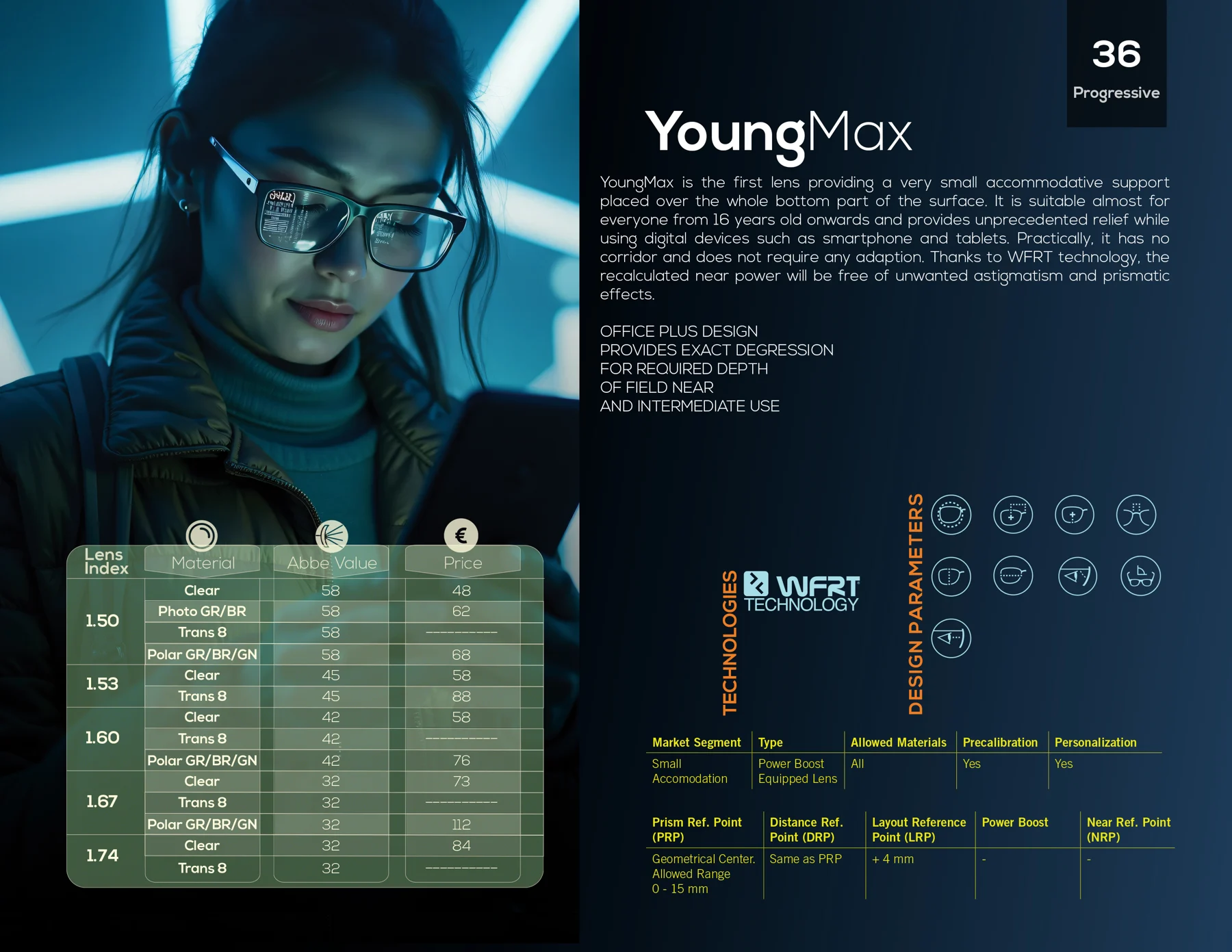
YoungMax
Considering younger users' accommodative needs
Explore design and specificationsPower Boost lens for accommodative needs with personalisation. Boost power is not stated in its table and must not be inferred from other products.
Application and design rationale
Accommodative support without assumed values
The table lists Small Accommodation and Power Boost Equipped but gives no boost power. Do not substitute another product's boost steps.
| Design identifier | Description |
|---|---|
| Design type | Power Boost Equipped Lens |
Technical specifications
Orderable options depend on prescription, material and current product availability.
| Technical parameter | Value / status |
|---|---|
| Product classMarket Segment | Small Accomodation |
| Design typeType | Power Boost Equipped Lens |
| Available materialsAllowed Materials | All materials |
| Pre-calibrationPrecalibration | Yes |
| PersonalisationPersonalization | Yes |
| Prism reference pointPrism Ref. Point (PRP) | Geometrical Center (0–15 mm) |
| Distance reference pointDistance Ref. Point (DRP) | Same as PRP |
| Fitting reference pointLayout Reference Point (LRP) | +4 mm |
| Power boostPower Boost | — (dash shown in the table) |
| Near reference pointNear Ref. Point (NRP) | — (dash shown in the table) |
| Inset / Auto Inset | Not stated |
| Corridor / Addition | Not stated |
| PRP decentration range | 0 to 15 mm |
| Specified indices and options | Materials 1.50 to 1.74 In various options; confirm final availability when ordering. |
Design mechanism and features
Supporting accommodation during near tasks
YoungMax is classed as Small Accommodation and a Power Boost Equipped Lens. It is described for adolescents and young adults needing near-work support; clinical selection depends on individual assessment.
Unspecified values are not estimated
YoungMax's table shows dashes for Power Boost and NRP, with no numerical inset or addition. No boost steps from ReadMax, RestMax or DigiMax have been transferred to it.
Positioning and differences from KidsMax
DRP coincides with PRP and LRP is listed as +4 mm. KidsMax is a children's PAL with 8 mm NRP and defined addition; YoungMax is different. These data do not prove guaranteed prevention of accommodative spasm or myopia.
Compare related designs
| Component | YoungMax | DigiMax | RestMax | ReadMax |
|---|---|---|---|---|
| Class | Small Accomodation | Medium Anti-Fatigue | High-end Anti-Fatigue | High-end Anti-Fatigue |
| Boost steps (D) | No value specified | 0.50, 0.75, 0.90 | 0.40, 0.65, 0.90, 1.10, 1.30 | 0.25, 0.50, 0.75, 1.00, 1.25, 1.50 |
| Personalisation | Yes | Yes | Yes | Yes |
| NRP | Not specified | Not specified | 18 mm | 18 mm |
Technologies in this design
- DuraTrace
- Ray-tracing calculations and optical-aberration optimisation in surface design.

Measure before manufacture
Required parameters vary by design and must be recorded by a professional.
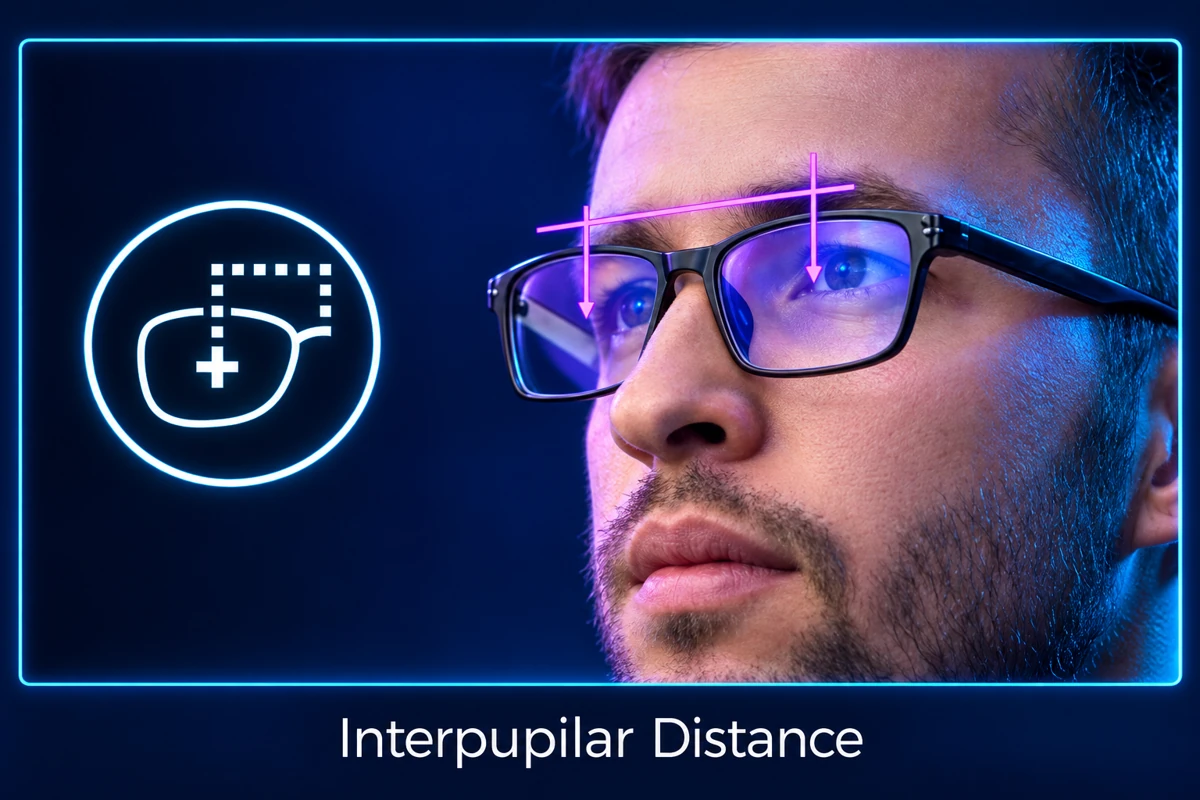
Monocular pupillary distance
For aligning the lens centre with each eye's visual axis.
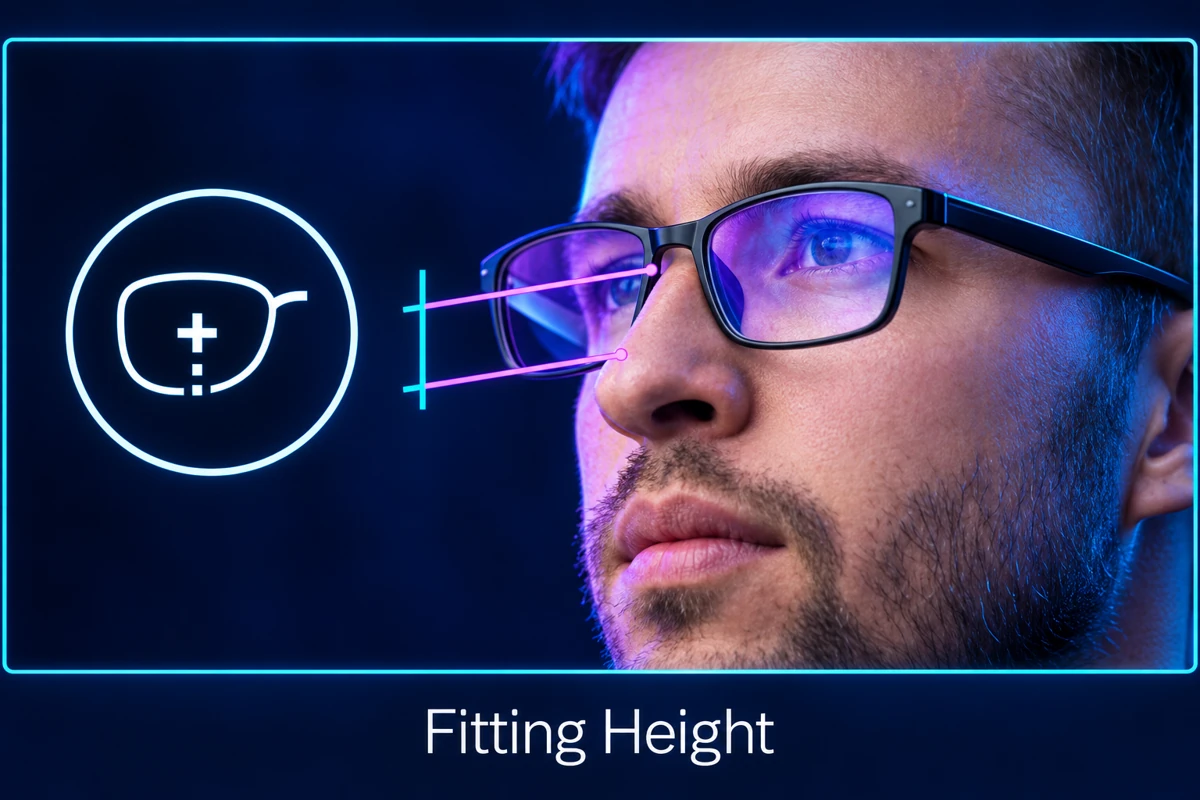
Fitting height
Vertical pupil position relative to the frame in the position of wear.
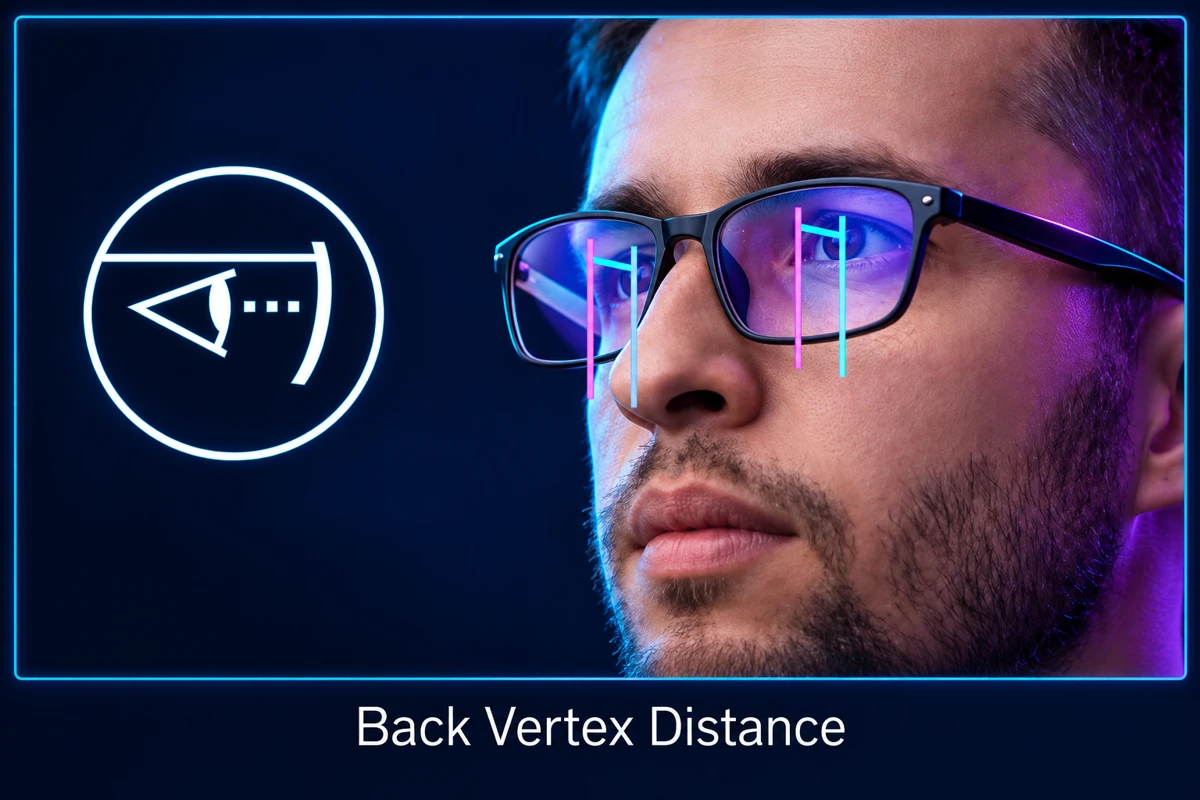
Back vertex distance
One of the inputs describing the actual position of wear.
These are basic fitting parameters; additional inputs and the level of personalisation are specified for each model.
Complete parameter guide ↖View the original catalogue page